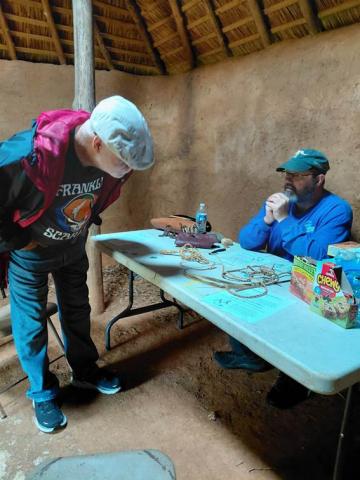
Volunteers and craftspeople came together this spring to share knowledge and skills practiced at Etowah Indian Mounds for centuries.
The Friends chapter of Etowah Indian Mounds and Etowah staff combined a volunteer workday with the Annual Tools & Weapons event. Volunteers focused on two garden areas. In the pollinator garden, they prepared the beds and added North Georgia native plants, coneflower (echinacea) and tickseed (coreopsis). Pollinator gardens attract insects that create strong ecosystems and healthy habitats. An unexpected plant volunteer also showed up—wild violets (viola sororia)—and was made welcome in the gardens.
The Three Sisters demonstration garden was the next focus. The specific three sisters planted are Cherokee Gem flint corn, Rattlesnake pole beans, and Patty-Pan squash. These companion plants have a millennia-long history in Southeastern agriculture. Cornstalks anchor the pole beans, which add nitrogen to the soil; meanwhile, squash leaves provide ground cover. Volunteers weeded and transplanted, delighted to discover a sprinkling of sunflower (helianthus) seedlings, another native plant.
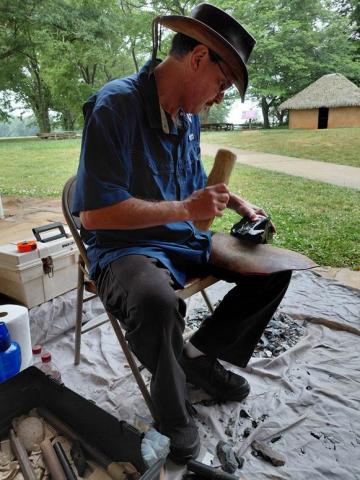
Four craftspersons continued the weekend’s activities. Carl and Edna Etheridge, Keith Bailey, and Randy Ballew set up demonstrations of tools and weapons for visitors. Carl and Edna shared archery demos, while Keith demonstrated how to make cordage from yucca fibers. Randy walked visitors through the art of flintknapping. Flintknapping is the process of making tools from stone. The resulting tools can be as useful and sharp as contemporary knives.
On the porch of the Etowah Indian Mounds museum, Randy smacked a glossy black rock with a deer antler. A chunk about the size of a cell phone came free in a process called “spalling.”
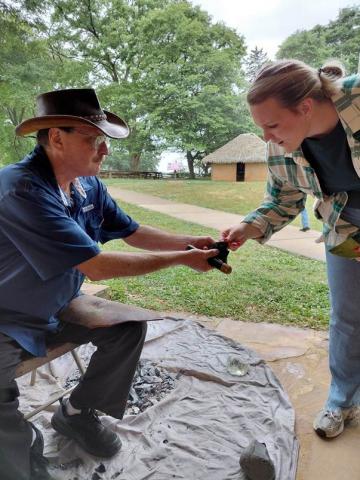
“What kind of rock is that?” asked a visitor. “That’s obsidian,” replied Randy. Was obsidian available in this geographical area, which is rich in chert and flint, during the Mississippian era (A.D. 800-1600)? The astonishing answer was “yes.” Trade routes between indigenous communities across North America—and beyond—were extensive. Material culture objects associated with Etowah include copper from the Great Lakes, marine shells from the Gulf Coast, and obsidian from the West.
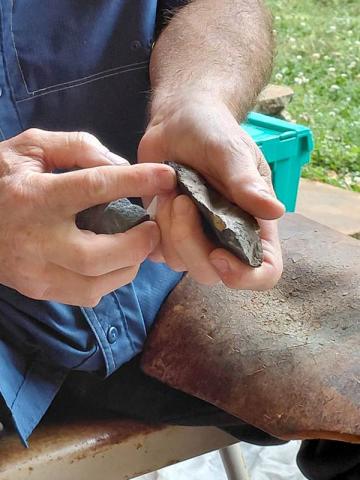
Switching to precision tools, Randy used “pressure flaking” to shape the spall into a triangular blade. Next, he thinned the blade, sharpened an edge, and added notches at the base. Notches allow the blade to be bound to an arrow shaft, spear shaft, or knife handle.
Randy caught the flintknapping bug from Carl. "I watched Carl so long that day his wife said she was leaving," he said, laughing. "She went to the car, and I talked to Carl for hours." He studied with Carl, and for over twenty years, Randy has shared this art at Etowah.
These knowledges and skills help tell the stories of the Mississippian Indigenous peoples, and their descendants in the Muscogee Creek and Cherokee Nations.
Everyone is welcome to visit and volunteer at Etowah Indian Mounds State Historic Site. Upcoming events include the 4th of July and weekly tours on Saturdays and Sundays. To volunteer, visit the Friends of Etowah Facebook page.